




How Digital Housekeeping Speeds Up Room Turnaround in Hotels
Digital housekeeping speeds up room turnaround and ends the calls between reception and housekeeping.
In almost every hotel, there's a scene that repeats several times a day. A guest checks out. The room is free. The front desk calls housekeeping. Housekeeping reports back when the room is clean. The front desk notes it down, and only then can the next guest move in.
It's a common way of managing hotel housekeeping, but it isn't the most efficient one. Every call, check or wait adds a few minutes - and on peak season days those minutes quickly turn into hours of lost time.
Where the delays happen
In hotels without a digital system, housekeeping often works with incomplete information. The day starts with a printed list or verbal instructions, and then the situation keeps changing. One guest checks out early, another extends their stay, and a particular room suddenly becomes a priority because a VIP guest is arriving.
That information travels by phone, by message, by shouting down the hallway. Each interruption is a small pause in the work, and across a team of five or six housekeepers those pauses quickly add up to a real operational cost.
What a digital housekeeping module changes
When the housekeeping module is connected to the PMS, information updates automatically and is available to everyone in real time.
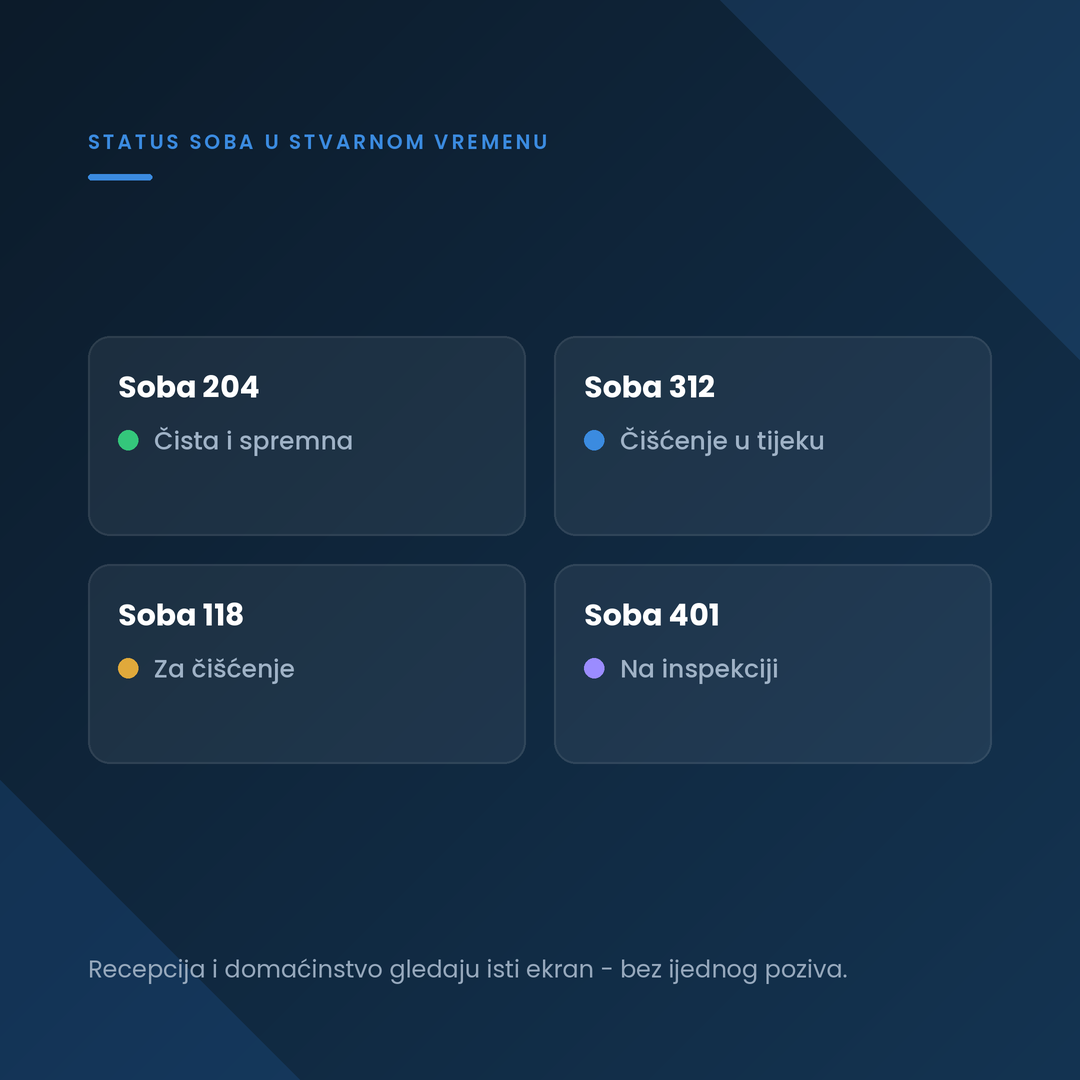
After a guest checks out, the room immediately switches to "to be cleaned" status. Housekeeping staff see the change on a mobile device or tablet, and the front desk knows at any moment which rooms are ready for check-in - without a single call.
Every room always has a clear status:
occupied
to be cleaned
cleaning in progress
under inspection
clean and ready
This removes unnecessary calls, double-checking, and the risk of assigning a guest a room that isn't ready yet.
A fairer workload distribution
One of the less visible but very important benefits of a digital system is a fairer distribution of tasks.
With manual planning, it's easy for one housekeeper to get ten checkouts while another has only three stayover rooms - not because anyone wants it that way, but because no one has a complete real-time overview.
A digital module assigns tasks automatically and evenly, based on room status and staff availability, so everyone immediately sees their own schedule on their device without extra coordination. The result is better-organized work and less strain on individuals.
Priorities that shift in real time
Hotel operations rarely follow a plan without changes. An early arrival, an extended stay or an urgent request for a specific room are everyday situations.
A digital housekeeping system lets priorities change instantly. If a room has a new guest arriving the same day, it automatically gets a higher priority and moves to the top of the task list.
As a result, the time between one guest's checkout and the next guest's check-in is noticeably shorter - not because staff work faster, but because they no longer lose time on coordination.
Data that actually helps you plan
A digital system also gives you a complete overview of housekeeping operations. Management can track the average cleaning time, the workload per day and the current status of every room.
That data makes it easier to plan shifts, optimize labor costs and make decisions based on real metrics.
Less waiting, faster check-in
Housekeeping that doesn't depend on phone calls isn't a luxury - it's the operational standard of a modern hotel. When everyone works from the same real-time information, rooms are ready faster, staff work more efficiently, and guests get a better experience from the moment they arrive.
→ See how the housekeeping module works in practice - Hologic demo
More articles

