




How a Modern Hotel POS System Works - Beyond a Cash Register
A modern hotel POS system automates restaurant, front desk, billing, and inventory operations in real time.
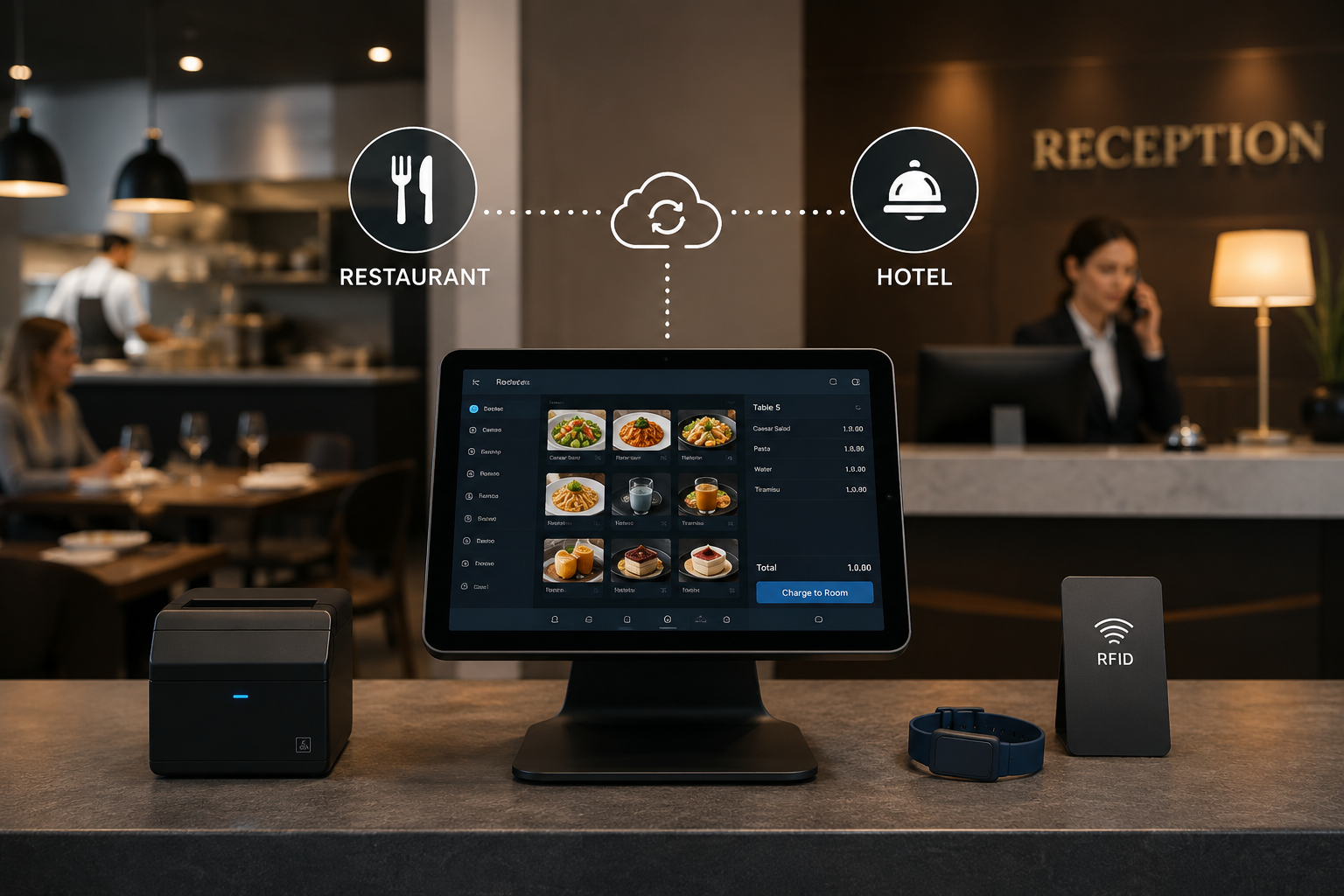
Most hotels think they have a POS system. In reality, they have a digital cash register.
That’s not an insult - a cash register does exactly what it was designed to do. It takes orders, processes payments, and closes shifts. In a standalone restaurant, that’s usually enough.
But in a hotel, “good enough” creates departments that don’t communicate, invoices that need manual reconciliation, and check-outs that depend on whether a waiter correctly wrote down the room number the night before.
A modern hotel POS system is not an upgraded cash register. It’s a completely different category of tool. In a hotel, the restaurant is not a separate business. It’s part of the guest experience - and part of the same operation.
What a Modern Hotel POS System Automates
A cash register knows what was ordered and how much it costs.
A POS system built for hotels also knows who placed the order, which room they are staying in, what’s included in their package, and where the charge should be posted - automatically, without the waiter asking a single question.
That difference - between a system that tracks transactions and one that understands the guest - changes how the entire restaurant operates.
In hotels without an integrated POS system, a large part of daily operations still depends on manually transferring information between the restaurant and the front desk.
What a Modern Workflow Looks Like
Shift Login Waiters log in using RFID wristbands - no shared passwords, no waiting. Every transaction is automatically linked to a specific employee. Not to a shift or a terminal - to a person.
Taking Orders Orders are entered directly at the table using a mobile terminal. They are automatically sent to the kitchen display or printer - no paper slips, no verbal communication, no lost information between the dining area and the kitchen. Modifications, allergies, and priorities are all handled in real time.
Dish Ready Notifications When an order is ready, the waiter receives a notification on their mobile device. No walking to the kitchen to check. No cold food waiting because the waiter wasn’t nearby.
Payment and Room Posting With one click, the charge is posted directly to the guest’s room. The system already knows which guest is assigned to the table through the PMS profile. The waiter doesn’t ask for a room number. The guest doesn’t wait. The transaction is instantly visible to the front desk in real time.
What the Manager Sees
Without an integrated POS system, a hotel restaurant manager has two ways to understand what’s happening: ask someone or wait for tomorrow morning’s report.
With a modern POS system, the dashboard is available in real time - from any device.
Prices and Menu Items in One Place
Changing the price of a single item in a disconnected system often means updating multiple places at once. If one location is forgotten, inconsistencies appear - on invoices, in the system, or during payment processing.
With centralized management, a change is made once and immediately applies everywhere. No manual reconciliation between the restaurant, front desk, and billing systems. Fewer mistakes, faster workflows, and more confident staff.
Inventory Control That Actually Works
F&B is one of the hardest parts of hotel operations to keep profitable. Not because it lacks potential - but because costs are often invisible until it’s too late.
Every sale automatically updates inventory levels. Waste, spoilage, and small shortages become visible in the data instead of only being discovered during physical stock checks.
Managers can see when inventory drops below critical levels and react before problems appear. This isn’t a revolution. It’s the foundation of cost control that simply doesn’t exist in hotels without an integrated POS system.
A Modern Hotel POS System Is Not Just a Billing Tool
It’s the operational center of the restaurant.
When it works that way — when waiters are free from administrative questions, when the kitchen receives orders without friction, when the front desk sees all guest charges without reconciliation, and when managers have real-time operational data - the restaurant stops being a cost center that needs to be covered and becomes a revenue source that differentiates the hotel.
That difference is not a technical detail. It’s something you feel every day, in every shift, on every bill.
→ See how Hologic POS connects restaurant operations, front desk workflows, and billing in a real hotel environment - Hologic demo
More articles

