




How to Reduce Hotel Energy Costs: 5 Fixes That Work
Most hotels overspend on energy without knowing it. See the 5 most common causes and how smart room automation fixes them automatically.
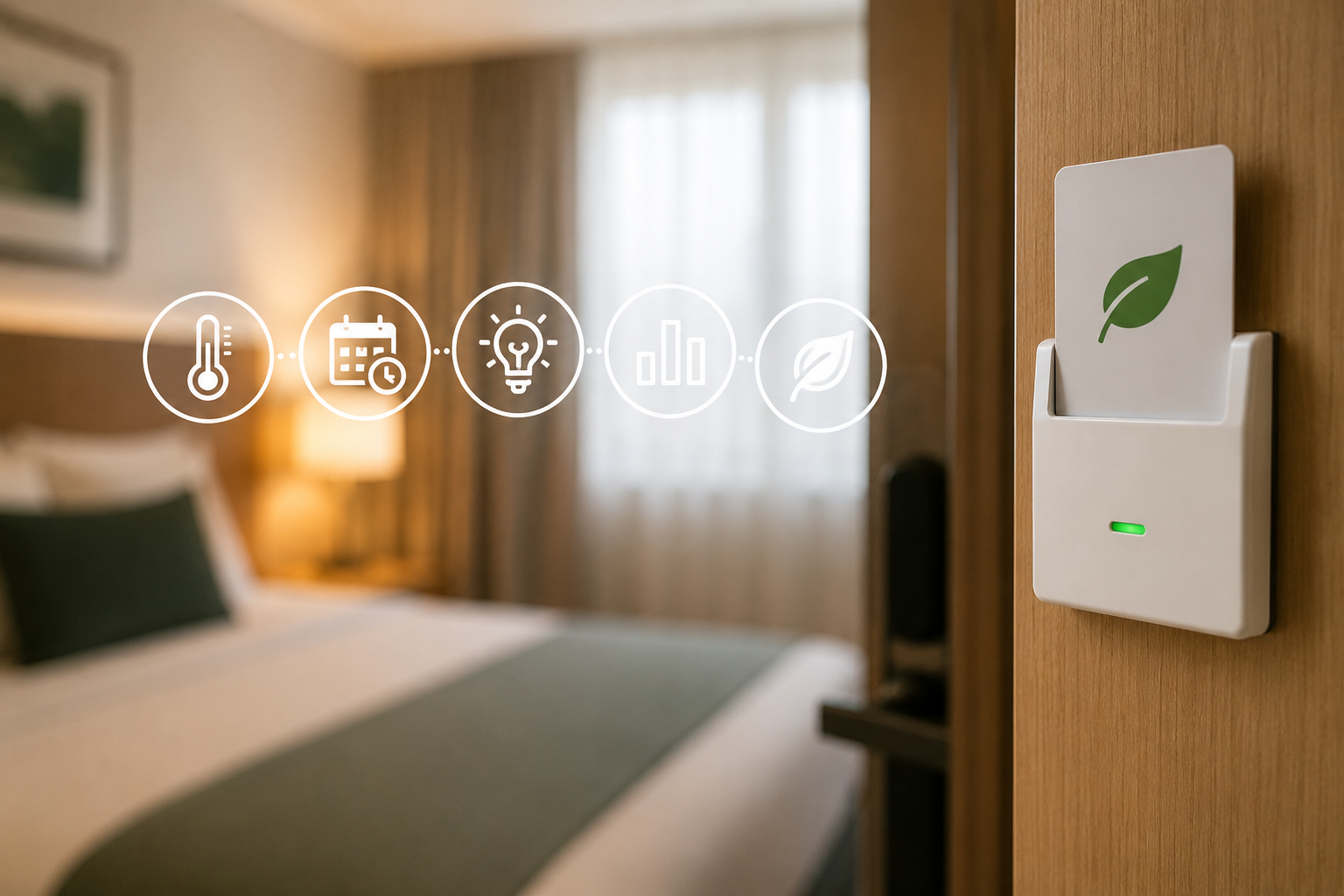
After their first season with the Hologic system, one hotelier noticed significantly lower energy bills - and called us to check if something was wrong. Nothing was wrong. The system had simply stopped heating and cooling empty rooms.
The average hotel spends hundreds of euros per room each year on energy alone. Some of that cost is unavoidable. Much of it isn't. The real problem isn't consumption itself - it's the fact that energy is often used with no actual need. In empty rooms, unused spaces, and through systems running at full capacity regardless of whether anyone is there.
How to reduce energy costs in your hotel
Most unnecessary energy waste in hotels comes from a few recurring scenarios: air conditioning running in empty rooms, lights left on, and shared spaces operating at full capacity regardless of occupancy. The good news is that a large part of these costs can be reduced through automation - without affecting the guest experience. Here's where hotels most commonly lose money.
Issue 01 - Air conditioning in empty rooms
This is the most common and most expensive problem, and nearly every hotel without automation has it. A guest leaves in the morning, and the air conditioning keeps running all day because the system doesn't know the room is empty. Across dozens of rooms, that cost adds up fast.
Issue 02 - Room too cold or too warm when the guest arrives
This looks like a comfort problem at first. But it's an energy problem too. When a guest walks into an uncomfortable room and sets the thermostat to maximum, the HVAC system has to compensate for a large temperature gap all at once - consuming significantly more energy than gradual temperature maintenance would.
Issue 03 - Lights and devices running for no reason
Lights left on. TVs in standby mode. Devices drawing power around the clock even when no one is using them. Individually, these costs seem minor. Over a full year across dozens of rooms, they become part of a bill that didn't need to exist.
Issue 04 - Shared spaces running at full capacity for no reason
Energy optimisation usually focuses on rooms - but a significant portion of consumption often comes from shared spaces. Wellness areas, conference rooms, corridors, and underground parking frequently run at full capacity regardless of whether anyone is using them.
Issue 05 - You don't know where the energy is actually going
A hotel that doesn't track consumption by room, zone, or time of day can't optimise it. It doesn't know which room is overconsuming. It can't compare this season to last. It doesn't know whether morning usage is higher than evening. Without data, every decision about energy efficiency is a guess. And guessing rarely pays off.
What actually changes when the system starts working
The hotelier who called us after their first season didn't have a problem. They had a result they didn't expect - a significantly lower energy bill than the year before. For a 50-room hotel, the Hologic smart room platform typically delivers a visible return on investment within one to two seasons. Not because the technology is complex, but because it automates what staff physically can't monitor - every room, every hour, every day. If you've ever looked at an energy bill and thought "this could be better" - you were probably right.
→ Calculate how much your hotel could save: Hologic demo
More articles

